Hey everyone, Araminta here!
Like most marketers, you’ve probably seen website clicks decreasing across the past few months.
People in the SEO world are calling it the "great decoupling of impressions and clicks", which previously used to grow at the same rate together and no longer does -- impressions are rising and clicks are decreasing (and yes, it looks like a crocodile).

First off, this is normal. Across most of our clients, we’ve also seen a decrease of organic clicks over the past year of anything between 2% and 13%.
The decrease in clicks is seen as a problem is because for many years, traffic was the main KPI for content. Freelancers, agencies, in house teams… the main measure of their success was based on traffic.
But showing how your traffic is now decreasing over time (which used to only increase) to executives doesn’t look too good.
So what can be done?
Why are clicks decreasing?
The main reason clicks are decreasing is because of AI Overviews (AIO), the short AI summary that you see at the top of the results page.
For many queries, this summary box does the job: it answers the user's question directly, and therefore they don’t need to scroll down and click on a URL.
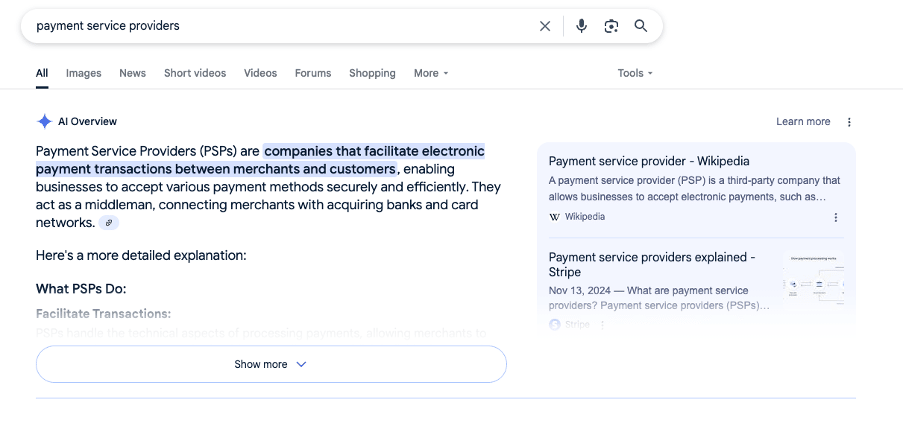
As a brand, you may still be visible if you appear on the right of the summary box, but because no one’s clicking you’re not getting traffic – hence why impressions are increasing but clicks are decreasing.
In fact, according to Kevin Indig’s study, 7 in 10 searchers never read past the first third of an AIO. That’s why websites are seeing a 34.5% decrease in clicks, according to Ahrefs’ study.
Should we be trying to increase clicks?
The issue I see is that we then get clients and prospects that ask us: how do we increase clicks? What can we do?
But I wouldn’t say this is the right approach. Clicks, now, will likely remain low. Even if they do go up, I don’t believe this is the right metric to track the success of content anymore.
Trying to increase clicks is a losing person’s game because we’re entering a “zero click” era, where people can consume content without having to click on anything.
And therefore, a decrease in clicks doesn’t mean you’re less visible or that you are bringing in fewer customers.
Clicks and traffic are simply not the right metrics anymore.
What we need to do here is stop trying to "increase clicks" and move away from traffic as the main KPI.
So… what do we track instead?
In one word: conversions.
Yes traffic is so much easier to track than conversions, and conversions are hard and messy to track accurately because of how complex the buyer journey is online.
But conversions are also more accurate and a better representation of the impact of content. Content does more than just increase brand awareness, it actually generates and closes deals. It brings in revenue.
And that’s what we’ve been seeing across our clients: although traffic has been decreasing for many of our clients, conversions have been on the increase.
Here’s an example of clicks vs conversions for one of our clients across the same time period:
The clicks:

The conversions:
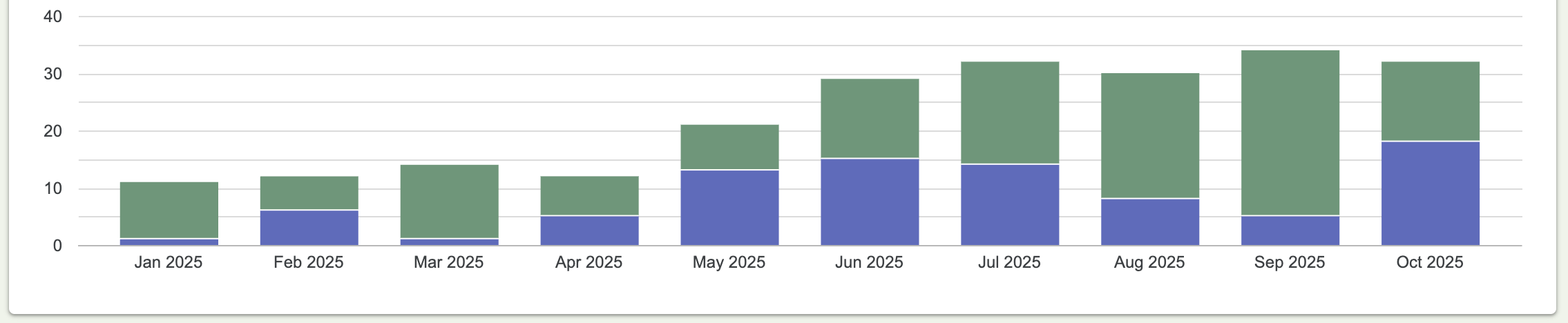
Tracking conversions also makes the conversations with leadership a lot easier, since you can show that the trend is positive and how it correlates to revenue.
Without tracking conversions, you're stuck with a decreasing traffic graph which makes it look like what you're doing is not working.
By tracking conversions, you are back in control and can more easily show when content is working.
In addition to conversions, there are a few other metrics you can track:
- Rankings on Google: still relevant since the higher you rank the higher your online visibility
- LLM visibility: the % of times your brand is mentioned in an AI chat. This will depend a lot on the prompts you track, but it’s also a good measure of visibility.
- LLM citations: the % of times your website is sourced in an AI chat.
- Self attributed conversions: asking users “How did you hear about us?” in your contact form to track whether they come from LLMs, organic, referrals, etc.
How do you track conversions?
What’s unfortunate is that tools like GA4 don’t make it easy to track conversions. If you have consent mode enabled, GA4 is essentially no longer reliable source of information. So you need to turn to your CRM.
If you use HubSpot, you can track first, last and multi touch attribution. This is what we like to track to see the impact of content every month. Full guide on how to set this up here: How to Track the Quality of the Leads Your Content Brings in [With 6 HubSpot Reports]
If you don’t have HubSpot, we recommend using a third party tool like WhatConverts, which allows you to see the whole journey a user goes through on your website. With these setups, what you can do is see how people are interacting with your content, and most importantly, multi-touch attribution (which is how content really works in a buyer journey).

With conversion tracking, your graphs start to look very different. Instead of a decreasing trendline that looks like things are not working, you instead not only have a positive trendline, but also metric that is also a lot closer to revenue and is a better representation of the impact of content (as seen in the example of our client's above)
We’re living in a changing and exciting time in SEO. LLMs are now part of the buyer journey. AI Overviews are now higher than position #1. Top of the Funnel content is no longer as important.
In order to adapt as marketers we need to move away from traffic as the main KPI for success of content. If your clicks are decreasing, it's a sign to set up conversion tracking and start using that as your main KPI for content success!
Mint Studios Recommended Reads
- How to Measure the Impact of Content Marketing in a Fragmented SEO Landscape: A good article that goes in more depth about how to measure conversions
- What is BOFU (Bottom of the Funnel) Content and Why Is it Important?: How do you grow conversions? Start with BOFU content, this explains how
- What Triggers AI Overviews? 86 Factors and 146 Million SERPs Analyze: Article that goes in more detail about AI overviews and the impact they are having
Thanks for reading,
Araminta & the Mint team 🎉
We help financial services and fintech companies acquire customers and position themselves as experts with content marketing. Learn more about what we do.